
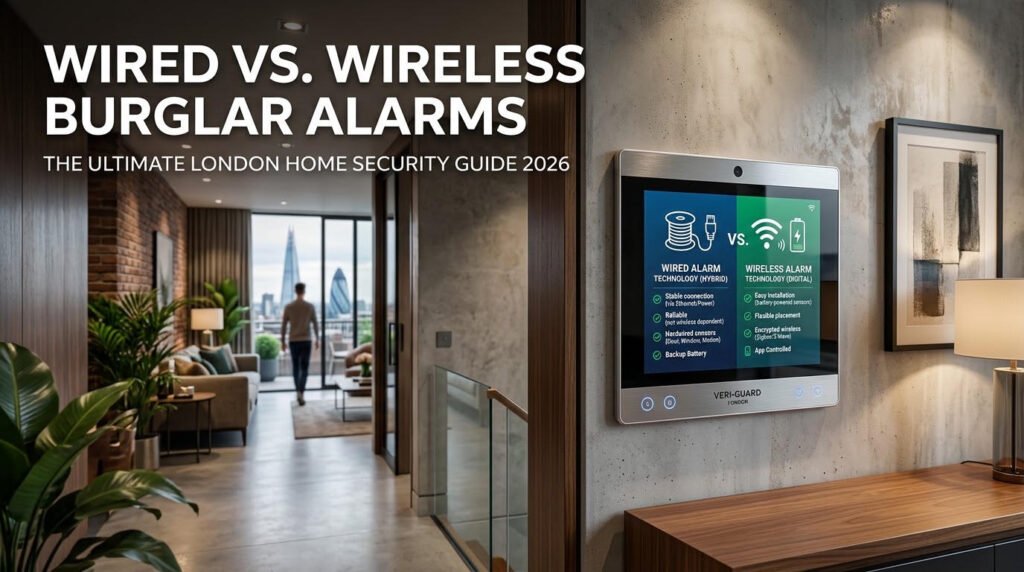
Protecting your home or commercial property against intrusion is one of the most important investments you can make. When choosing an intruder alarm system , one fundamental question constantly arises: Should you install a traditional hardwired alarm system or opt for a modern wireless burglar alarm?
Both technologies have evolved rapidly over recent years, with smart app integrations and encrypted communication leading the industry in 2026. However, factors like property type, budget, installation complexity, and maintenance requirements can significantly influence which option is best suited for you.
In this guide, we break down the pros, cons, and performance metrics of wired and wireless intruder alarm systems to help you choose the right winner for your property.
What Is a Wired Burglar Alarm System?
A hardwired burglar alarm system uses physical cables run behind walls, under floorboards, or along skirtings to connect all sensors, door contacts, keypads, and sounders directly to a central alarm control panel.
Advantages of Wired Alarms:
- Maximum Reliability: Physical cabling guarantees a consistent signal that is completely unaffected by Wi-Fi outages, distance, or thick stone walls.
- Low Maintenance: Because sensors receive power directly through the main wiring, you don’t need to worry about replacing sensor batteries every few years.
- Ideal for Large Commercial Buildings: Hardwired systems can easily span large premises, warehouses, and multi-storey commercial properties without signal range limitations.
- Cost-Effective Components: Individual wired sensors are generally less expensive than their wireless counterparts.
Disadvantages:
- Complex & Invasive Installation: Running cables often requires lifting floorboards or drilling through walls, making installation more labour-intensive.
- Higher Initial Fitting Costs: Due to the time required to neatly conceal wiring, labor costs during initial setup can be higher.
What Is a Wireless Burglar Alarm System?
Wireless intruder alarms connect sensors, motion detectors, and sirens to the main hub using secure, encrypted radio frequencies (RF). Modern smart wireless systems also connect seamlessly to your local Wi-Fi and mobile networks for real-time mobile app alerts.
Advantages of Wireless Alarms:
- Fast, Clean Installation: Without the need to run hidden cables through walls, wireless alarms can be installed quickly with minimal disruption to your decor.
- Ideal for Renters & Listed Buildings: Perfect for rented properties, historic homes, or decorated apartments where drilling and cabling aren’t permitted.
- Easy Scalability & Relocation: Adding extra door contacts, PIR sensors, or panic buttons is effortless, and the entire system can be removed and relocated if you move house.
- Smart App & Remote Control: Receive instant push notifications on your smartphone, arm/disarm remotely, and check system status anytime.
Disadvantages:
- Battery Replacement Required: Wireless detectors rely on internal batteries that typically need replacing every 2 to 3 years.
- Range Restrictions: In properties with very thick concrete or solid brick walls, wireless signals may require signal boosters/repeaters.
Head-to-Head Comparison: Wired vs. Wireless
Installation Time:
• Wired Alarm: Longer, labour-intensive (cable routing)
• Wireless Alarm: Quick, clean, non-invasive setup
Signal Reliability:
• Wired Alarm: 100% stable physical cabling
• Wireless Alarm: High reliability via encrypted RF & cellular backup
Maintenance & Upkeep:
• Wired Alarm: Minimal (panel battery backup test)
• Wireless Alarm: Sensor battery changes every 2–3 years
Flexibility & Expansion:
• Wired Alarm: Requires adding physical wiring for new sensors
• Wireless Alarm: Effortless wireless pairing for new devices
Property Suitability:
• Wired Alarm: New builds, full renovations, large commercial sites
• Wireless Alarm: Existing homes, flats, rented properties, listed buildings
Grade 2 / Grade 3 Compliance:
• Wired Alarm: Fully compliant for Grade 2 & Grade 3 commercial setups
• Wireless Alarm: Fully compliant for Grade 2 residential/commercial setups
Which Security System Wins in 2026?
The “winner” ultimately depends on the current state and layout of your property:
1. Choose Wireless if: You are adding security to an existing decorated home, flat, or rented space in London, want minimal disruption, and value smartphone app integration with easy expansion options.
2. Choose Wired if: You are building a new extension, undergoing a full property renovation, or managing a large commercial site where cables can be pre-fitted behind walls prior to plastering.
Professional Alarm Installation & Servicing by HiTechno
At HiTechno, we supply and fit certified, Grade-compliant wired and wireless intruder alarm systems across London and its surrounding areas. From smart app-controlled wireless kits for homes to fully monitored commercial alarm setups, our engineers deliver tailored protection designed to keep intruders out.
Protect your home or business with a custom security solution today!
 Call our experts at 0203 3088757 or email info@hitechno.co.uk for a free property assessment and fixed quote.